


 The Classics
 The Barrels
 La Folle Blanche
 Extra Old Cognac
 Gastronomy
 Grape varieties
 Blends
 Family
 Vineyard
 Environment
Folle blanche: the grape that made cognac
An almost forgotten grape variety
Folle blanche is now one of the great absentees of the Cognac vineyard: it accounts for less than 1% of the vines planted in the region. Yet it was the dominant variety before the phylloxera crisis of the 1870s. This article tells its story, explains why it almost disappeared and what it still brings to the glass.
A Charentais grape with a surprising name
Folle blanche is a white grape variety that has long been grown in western and south-western France. Depending on the region, it is also called gros plant, picpoul or enrageat blanc. Its name is said to come from its vigour and its unpredictable yields: a “mad” (folle) vine has character and does not always let itself be tamed.
Until the 20th century, it was the traditional grape of cognac and armagnac. Before phylloxera, it dominated the Charentais vineyard.
From phylloxera to ugni blanc
In the 1870s, phylloxera, an insect from America, ravaged the Charentais vineyard. Folle blanche, which is very sensitive, was decimated. To replant, winegrowers chose hardier varieties, and ugni blanc took over: disease-resistant, productive, late-ripening, low in alcohol and very acidic, which suits distillation well. The full story of this crisis is told in our article The phylloxera crisis in Cognac (in French).
Today, ugni blanc covers more than 98% of the Cognac vineyard, against less than 1% for folle blanche. Baco blanc (or baco 22 A) was created by crossing folle blanche with an American hybrid, noah, precisely to withstand phylloxera. Folignan, allowed under the cognac specifications since 2005, is another heir of folle blanche: a cross with ugni blanc.
A difficult grape to grow
Folle blanche is vigorous and productive, but fragile. It is prone to downy mildew, black rot and above all grey rot. Its early budburst exposes it to spring frosts, and its yields remain irregular.
Its base wines are very acidic and rather rustic: they are made for distillation, not for the table. These whims explain why more reliable varieties were preferred after phylloxera.
What it brings to the glass
Folle blanche eaux-de-vie are renowned for their finesse. Their high acidity and delicate floral, lemony aromas (jasmine, citrus fruit) lend elegance to cognac.
At Michel Forgeron, the house describes its youngest folle blanches as fresh, fruity and floral. The older ones gain depth and complexity, with smoky, iodine and lightly peaty notes that recall certain whiskies, while remaining fully cognac.
Folle blanche today
It has not disappeared. In France, according to Wikipedia, plantings fell from 15,865 hectares in 1958 to 1,770 hectares in 2009, but it survives in Charente, in Armagnac and in the Nantes region, where it gives gros plant, a very dry, lively white wine.
In Charente, it is now grown mainly by small producers committed to its style, sometimes as a single-variety cuvée, sometimes in blends.
At Michel Forgeron: 5 hectares in Grande Champagne
The Forgeron family grows 5 hectares of folle blanche in the heart of Grande Champagne, the first cru of the Cognac appellation. Each harvest is distilled using the traditional Charentais method, then aged in French oak casks in the house’s cellars in Segonzac.
Three cognacs let you discover this grape variety:
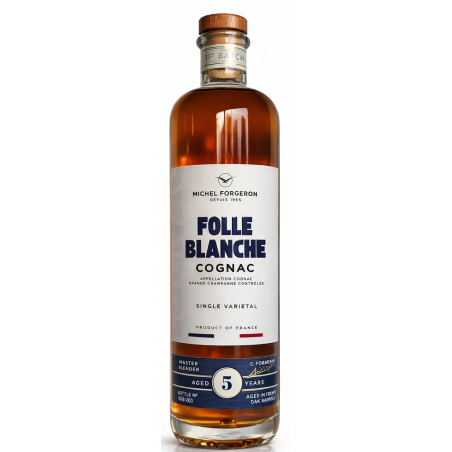 Folle Blanche 5 yearsThe youngest of the range: fresh, fruity and floral. Perfect as an aperitif, neat or over a large ice cube.
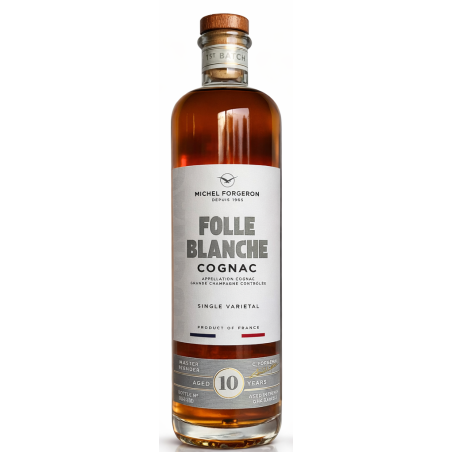 Folle Blanche 10 years100% folle blanche, aged 10 years. A hit at Whisky Live Paris when it was launched.
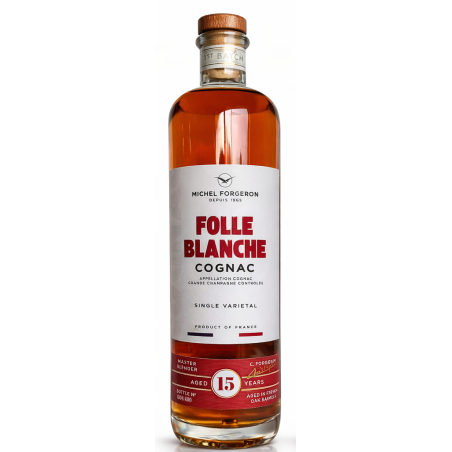 Folle Blanche 15 yearsThe oldest of the range: depth and complexity, between smoky and briny notes.
Discover the whole collection on the La Folle Blanche page.
Frequently asked questions
What is folle blanche?
It is a historic white grape variety of cognac and armagnac. Very acidic and delicate, it gives fine eaux-de-vie, but it is fragile and temperamental in the vineyard.
Why did ugni blanc replace folle blanche?
Because of the phylloxera of the 1870s. Ugni blanc resists disease better, yields more and suits distillation well. It now covers more than 98% of the Cognac vineyard.
Can you taste a folle blanche cognac?
Yes, but it is rare: the variety accounts for less than 1% of the vineyard. The house of Michel Forgeron offers three, aged 5, 10 and 15 years, from its own vines in Grande Champagne.
To go further: The six crus of cognac, Ageing of cognac and What does XO mean?.
Sources
- Folle Blanche grapes – cognac.com
- Folle blanche – Wikipedia
- The La Folle Blanche page on cognacforgeron.com (the family’s vines, descriptions of the cognacs)